

NEMA (National Electrical Manufacturers Association) elevator control cabinets serve as the "brain" of elevator systems, and their precision sheet metal processing is a core link ensuring safe, stable, and reliable operation. The entire process integrates advanced design, high-precision manufacturing, and strict quality control, far beyond simple metal forming.
It all starts with precise design. Engineers will conduct customized designs based on the specific parameters of the elevator (such as load, speed) and installation environment.

The conversion of design drawings into solid components relies on a series of high-precision sheet metal processing techniques.
This is the first step in cutting the entire metal sheet (such as cold-rolled steel plate, stainless steel plate) into the required part outline.
Laser cutting: As a mainstream process, it uses high-energy-density laser beams for cutting, with an accuracy of up to ±0.1mm, and the cuts are smooth and burr-free. It is especially suitable for processing parts with complex hole positions and special-shaped contours, such as mounting plates, side panels, etc.
CNC stamping: For parts that require a large number of standard holes (such as cooling holes, mounting holes), CNC punching machines are more efficient.
The cut flat plates are transformed into cabinet frames, door panels and mounting brackets with a three-dimensional structure through a bending machine.
CNC bending: The computer accurately controls the bending angle and sequence to ensure that the dimensional error of each bend is controlled within a very small range (such as ±0.5°).
Mold and Precision: High end applications will use precision molds, such as the double folding mold designed for the elevator and control cabinet industry, which can control the bending size error within ± 0.1mm and effectively avoid leaving pressure marks on appearance parts such as stainless steel plates, ensuring assembly accuracy and aesthetics.
When combining various sheet metal parts into a complete cabinet, connection technology is crucial.
Welding: Parts such as cabinet frames that require high-strength permanent connections usually use CO₂ gas shielded welding or laser welding to ensure that the welds are firm and without pores.
Pressure riveting: This is a major feature of control cabinet assembly. In order to facilitate the installation and maintenance of components, fasteners such as nuts and studs are pre-pressed into the mounting plates and partitions in the cabinet. The pressure riveting connection surface is flat and will not cause thermal deformation like welding, and the connection is reliable.
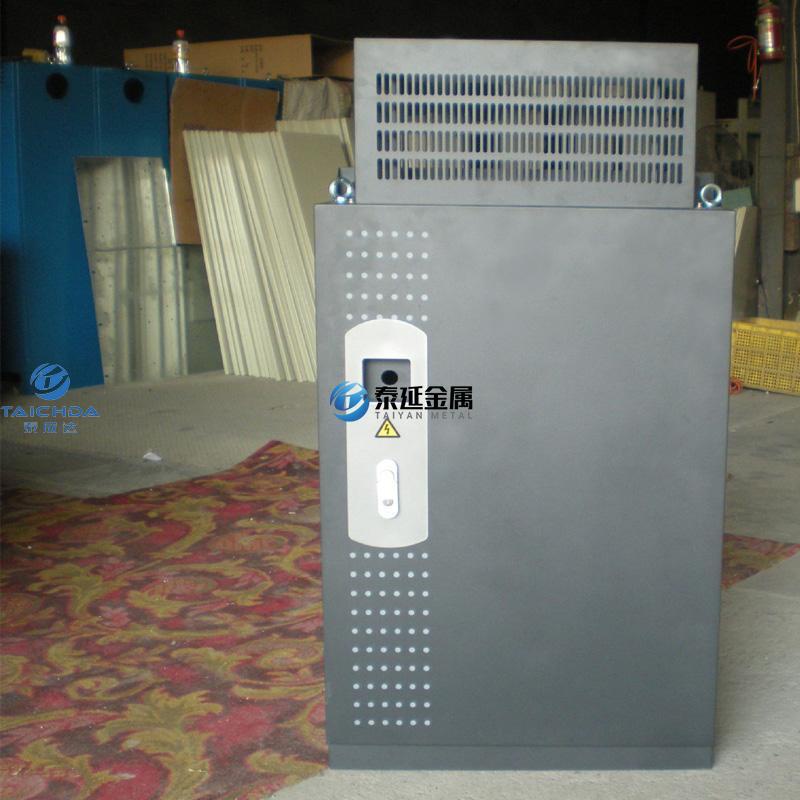
Handling and assembly after precision machining are key steps in giving the control cabinet its final performance and appearance.
In order to improve the corrosion resistance, aesthetics and electromagnetic shielding performance of the power control cabinet, strict surface treatment will be carried out.
Pre-treatment: including degreasing, phosphating and other processes to provide a clean and strong adhesion base for spraying.
Electrostatic powder coating: This is the most common surface treatment. The powder coating is evenly sprayed on the surface of the cabinet through electrostatic adsorption, and then solidified at high temperature to form a dense, wear-resistant protective layer. The color is usually industrial standard colors such as RAL7035 (light gray).
This is the process of implanting the "brain" into the "body".
Component installation: Strictly follow the design drawings, install circuit breakers, contactors, PLC controllers and other electrical components on the guide rail or mounting plate, and use locking screws to fix them.
Standardized wiring: The wiring process is extremely sophisticated. Lines with different voltage levels (such as 220V power lines and 24V signal lines) will be arranged in separate slots to avoid signal interference. All wires will be covered with insulating sleeves and marked with clear wire number tubes to ensure that each line is accurate and facilitate later maintenance.
Quality control is not the final process, but runs through every link from raw materials to finished products.
Process inspection: After each process such as cutting, bending, and welding, the dimensions, angles, and weld quality of the parts will be inspected to ensure that non-conforming products do not enter the next process.
Finished product testing: The assembled control cabinet needs to undergo comprehensive performance testing, including:
Through the above series of precise and rigorous processes, an ordinary metal plate is finally transformed into a NEMA elevator control cabinet that ensures the safe operation of the elevator.
Common materials include cold-rolled steel sheet and stainless steel SUS304. The appropriate material depends on the installation environment, corrosion resistance requirements, and cabinet design.
Common processes include laser cutting, CNC stamping, CNC bending, welding, pressure riveting, surface treatment, and precision assembly. Each process contributes to the cabinet's dimensions, structural strength, and assembly quality.
The protection rating helps determine the cabinet's suitability for its installation environment. Dust, moisture, and other environmental factors can affect internal electrical components, so the required protection level should be established during the design stage.
Quality checks can include dimensional and weld inspections, insulation resistance testing, functional testing, and verification that the cabinet's sealing meets the protection level specified in the design.


 IPv6 network supported


